You Have Your License—Now What? The Beginner’s Guide to Essential Gear.
Congratulations! You’ve passed Hunter Safety, Range Day, and your license is sitting in your wallet. The transition from “student” to “hunter” is exhilarating, but if you walk into a big-box outdoor store right now, you’ll likely feel like you need a second mortgage just to get started.
Here’s the truth: You don’t need the $600 carbon-fiber tripod or the latest scent-blocking tech just yet. You need the basics that keep you safe, legal, and comfortable.
1. The “Big Three” Basics
Before you buy a single camouflage item, focus on these:
The Right Tool: Depending on your season, this is your rifle, shotgun, or bow. Spend your time at the range, not the checkout counter. Proficiency and a tight grouping are more important than the price tag. Hone your skills, handling, and safety. We can get into more options in this area later when we discuss specific game to hunt.
A Quality Knife: You don’t need a Rambo blade. A sturdy, 3-to-4 inch fixed blade or a replaceable-blade knife (like a Havalon) is essential for field dressing. If you wanted to, you could go for a decent portable field dressing kit depending on what makes you comfortable.
A Comfortable Pack: You need a way to carry water, snacks, your license, and your first-aid kit. Any sturdy backpack will do for your first few trips. You will learn more about what you like, don’t like, or even need frankly.
2. Clothing: Think Layers, Not Brands
Avoid cotton at all costs—it gets cold when wet. Instead, look for:
Moisture-wicking base layers: To keep sweat off your skin.
Insulation: A fleece or “puffy” jacket.
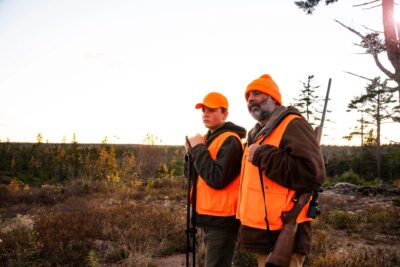
The “Orange” Requirement: Check your local laws, but a high-visibility vest and hat are usually mandatory and your most important safety items.
3. Navigation and Safety
Never enter the woods without a way to get out.
Communicate: Tell a hiking/hunting partner, family, or friends of your plans, where you will be, and the times you will be there in case something happens, they would know where to start.
GPS Apps: Download an app like onX Hunt or Gaia GPS. They show property lines, so you don’t accidentally trespass.
First Aid: Carry a basic kit including a tourniquet and an emergency whistle.
Hydration: Carry an extra bottle of water or two. Maybe even pack a light snack or two.
Pro Tip: Buy your boots first. If your feet are cold or blistered, your hunt ends early. Don’t skimp on footwear!
First, each state may be a bit different, so we recommend checking the latest details, processes, rules and regulations for your hunting state.
Second, getting your hunting license in Kentucky is a rite of passage, but the process has a few specific steps—especially when it comes to the safety requirements. If you were born on or after January 1, 1975, Kentucky law requires you to carry a hunter education card in addition to your license.
Here is your step-by-step guide to getting field-ready in the Bluegrass State.
Step 1: Complete Your Hunter Education Course
Kentucky offers two main ways to complete the classroom portion of your safety training. You must be at least 9 years old to take the course.
Option A: The Hybrid Path (Most Popular) Complete the “knowledge” portion online at your own pace. There are several state-approved providers (like Hunter-Ed or HECourse). Once you pass the online exam, you’ll receive a Range Day Voucher. (At least one of us completed this way, it was relatively straight forward and had good information.)
Option B: The In-Person PathAttend a traditional, instructor-led classroom session. These are often held at local sportsmen’s clubs or community centers and typically last 1-2 days.
Step 2: Attend a Mandatory “Range Day”
If you chose the online path, you must attend an in-person Range Day to finalize your certification. You cannot buy a permanent license without this.
What to Expect at Range Day:
Safety Instruction: Instructors will review firearm handling, tree stand safety, and zone-of-fire awareness.
Live-Fire Exercise: You will demonstrate that you can safely handle and fire a weapon.
The Equipment: Don’t worry about gear—the Kentucky Department of Fish & Wildlife Resources (KDFWR) typically provides the firearms and ammunition for this session at no cost.
Final Certification: Once you successfully complete the range activities, you’ll be issued your orange Hunter Education Card. This card is good for life and is recognized in all 50 states.
Pro Tip: Range Days fill up fast, especially right before deer season. Check the KDFWR Event Calendar early to reserve your spot.
Step 3: Choose and Purchase Your License
Once you have your safety card, you can head to the Kentucky Fish and Wildlife Online Store or visit a local vendor (like a bait shop, Academy Sports, or Walmart).
Common License Types:
License Type
Resident Fee (approx.)
Non-Resident Fee (approx.)
Annual Hunting
$27.00
$160.00
Youth (Ages 12-15)
$6.00
$10.00
1-Day Hunting
$7.00
$25.00
Sportsman’s Card*
$95.00
N/A
*The Sportsman’s Card is a great deal for residents; it includes your annual hunting and fishing licenses, plus permits for deer, turkey, and trout.
Step 4: Add Necessary Permits (Tags)
A general hunting license allows you to hunt small game (like squirrels or rabbits). However, if you are after “big game,” you need additional permits:
Deer Permits: Needed for both statewide and quota hunts.
Turkey Permits: Separate permits for Spring and Fall seasons.
Migratory Bird/Waterfowl: Requires a state permit and, for those 16+, a Federal Duck Stamp.
If you know you will be hunting more than one species, we’d recommend exploring the Sportsman’s Card annually as we’ve found it’s the best deal.
Short on Time? The Exemption Permit
If the season is starting tomorrow and you haven’t finished your course, Kentucky offers a one-time, one-year Hunter Education Exemption Permit. This allows you to hunt for one year without a safety card, provided you are accompanied by a licensed adult who is hunter-education certified.
Bonus Notes
Always check the KDFWR website and double-checking the exact season dates once they are officially released.
Your Range Day “Go-Bag” Checklist
Range Day is the final hurdle before you can hit the woods. Because most of the day is spent outdoors and involves active safety drills, you’ll want to be prepared.
1. The Essentials (Don’t leave home without these!)
Your Range Day Voucher: If you took the course online, you must bring a printed or digital copy of your completion voucher. No voucher usually means no entry.
Photo ID: Have your driver’s license or state ID ready for check-in.
Eye and Ear Protection: While many Kentucky ranges provide these, they can be “well-loved.” Bringing your own pair of safety glasses and foam earplugs (or muffs) ensures a comfortable fit.
2. Proper Field Attire
Closed-Toe Shoes: This is a safety requirement at every range. Boots or sturdy sneakers are best; sandals and flip-flops are strictly prohibited.
Weather-Appropriate Layers: Range Day happens rain or shine. In Kentucky, that might mean 40°F in the morning and 70°F by noon. Dress in layers you can shed.
A Hat: A simple baseball cap helps keep sun (and hot brass) away from your face.
3. Personal Comfort
Water and Snacks: These sessions can last 2–6 hours. Most ranges are in rural areas without vending machines, so pack a lunch and plenty of water.
A Camp Chair: You’ll be doing a mix of standing drills and sit-down instruction. A lightweight folding chair is a lifesaver during the briefing periods.
Sunscreen and Bug Spray: You’ll be spending a lot of time in open fields or near wood lines.
Note:Do NOT bring your own firearms or ammunition. To ensure a controlled safety environment, the Kentucky Department of Fish & Wildlife provides all the equipment and ammo needed for the live-fire portion of the day.
Have you ever wanted to learn how to go hunting? Better Late Than Never: We’ve always wanted to hunt, and we’ve been around it many times in our life however……we’ve never been the one on point and all that comes with it.
However, now that we’ve started and have a great group of friends to help us, we wanted to take this opportunity to share what we’ve learned over the last 3-5 years starting later in our lives. We’d like to share what has worked, what hasn’t worked, hear stories from others, and share products that we’ve tried in case it helps others.
Most hunting stories start with: “I was five years old when my dad first took me to the woods.”
That isn’t our story. And if you’re reading this, it may not be yours either. Let’s help others in our community to enjoy nature, get closer to God, and enjoy the fruits of his creation.
For many of us, the desire to hunt didn’t wake up until our 30s, 40s, or 50s. Maybe it was a desire for cleaner meat, a need to disconnect from the digital world, or finally had the means to try it out. Whatever the reason, we’ve arrived at the hunting trail a little later than most.
Ultimately, we’d like us to:
De-mystify the gear, the processes, and breakdown how you can do this. We will provide product reviews, eventually vlogs, and provide links to gear we are truly using.
Talk Tactics, breaking down “how-to” guides into steps that make sense for someone who didn’t grow up in a tree stand, in a ground blind, or trying to figure out what to do next.
Grow Together, sharing the mistakes, the “close calls,” and the eventual successes so we can all shorten our learning curves and enjoy the productivity.
Give back, by connecting with the community, participating in the Kentucky Hunters for the Hungry, and more.
It’s a long season, and the woods don’t care what year you were born. Let’s get started!
ID used to identify users for 24 hours after last activity
24 hours
_gat
Used to monitor number of Google Analytics server requests when using Google Tag Manager
1 minute
_gac_
Contains information related to marketing campaigns of the user. These are shared with Google AdWords / Google Ads when the Google Ads and Google Analytics accounts are linked together.
90 days
__utma
ID used to identify users and sessions
2 years after last activity
__utmt
Used to monitor number of Google Analytics server requests
10 minutes
__utmb
Used to distinguish new sessions and visits. This cookie is set when the GA.js javascript library is loaded and there is no existing __utmb cookie. The cookie is updated every time data is sent to the Google Analytics server.
30 minutes after last activity
__utmc
Used only with old Urchin versions of Google Analytics and not with GA.js. Was used to distinguish between new sessions and visits at the end of a session.
End of session (browser)
__utmz
Contains information about the traffic source or campaign that directed user to the website. The cookie is set when the GA.js javascript is loaded and updated when data is sent to the Google Anaytics server
6 months after last activity
__utmv
Contains custom information set by the web developer via the _setCustomVar method in Google Analytics. This cookie is updated every time new data is sent to the Google Analytics server.
2 years after last activity
__utmx
Used to determine whether a user is included in an A / B or Multivariate test.
18 months
_ga
ID used to identify users
2 years
_gali
Used by Google Analytics to determine which links on a page are being clicked